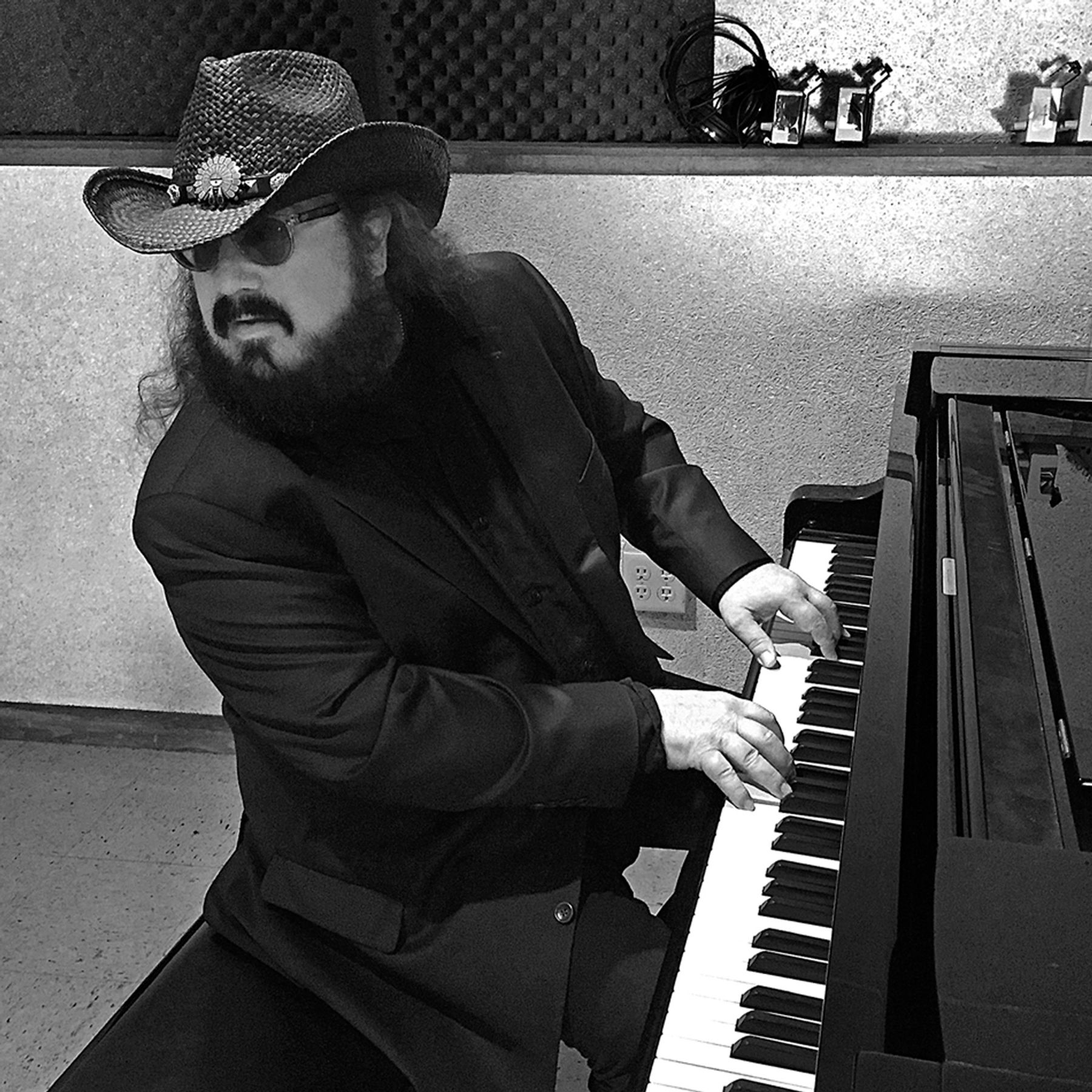
“ In a red-carpet event on Saturday June 2, 2018, Grayson Hugh was honored as ‘Top Soul Man For Our Time’ at the ROCK JUSTICE AWARDS in recognition for his decades of soulful performance, songwriting, album releases and jaw-dropping, barnstorming piano playing. Hugh, along with singer Polly Messer, completed a raucous two hour set upon a nine-foot concert grand piano before adoring West Coast fans who had a chance to connect again with their favorite artist.
‘Grayson Hugh demonstrates a freewheeling versatility in Soul, R&B, and Rock ‘n Roll,’ says Bennett Zimmerman, founder of the ROCK JUSTICE AWARDS Concert Series. ‘Grayson’s current albums are just as strong and satisfying as the ones he debuted with on the scene during the late 1980s. Grayson Hugh is a true soul master.’ “
- Sarah Tulowitzki, Canadian Business Tribune, June 8, 2018
“The duo of Grayson Hugh & Polly Messer really packed a punch, and with Hugh’s amazing song catalog, his dynamic piano performance, and the locked-in vocal harmonies between the two, the packed house was absolutely mesmerized. I am a huge fan!”
- Jeffrey Mainville, Manager of Visitor Experience Programs, New Britain Museum of American Art, August 5, 2019
“At the concert on Friday November 15th, Simsbury Public Library was fortunate indeed to hear an hour of world class music. Singer-songwriter and pianist Grayson Hugh, along with his wife singer Polly Messer, enthralled us with not only Grayson’s superb songs, but fascinating stories behind the compositions. Their performance, in front of a standing-room-only audience of 140, would have easily been at home in any venue several times the size . In an overwhelming response, people have asked us to bring Grayson and Polly back to sing for us often!”
- Lyndsay Neffinger, Adult Services Librarian, Simsbury Public Library, November 20, 2019
REVIEW OF "AN AMERICAN RECORD" (Swamp Yankee Records, 2010)
“On his album "An American Record" (Swamp Yankee Records 2010), Grayson Hugh sings of harbor towns and roads that don't look back, of thin trees and snow mountains, of mists rising from the sea and woods seen in soft southern light. He sings of mourning and disillusionment, of remembered love and lost time, of life scraped from the bottom of a lobster pot.
This is "An American Record". Some of us have been waiting for it a very long time.
I've been listening to Grayson for - Lord, has it really been that long? - 20 years, since I was a writer for Casey Kasem's countdown show and he was a young guy making his major label debut with a shades-of-Sam-Cooke soul stirrer called "Talk It Over". That song did everything except imprint itself on my DNA. His follow-up CD, "Road To Freedom", sealed the deal. I wrote about Grayson for Casey's show, wrote about him for Musician magazine, wrote about him in my music column for The Miami Herald, did everything but quit my job to follow him on tour, though I may even have considered that for half a second.
I wanted people to listen, to hear what I heard. Because this was music that told the truth.
Do you know how rare that is? Surely you've had that feeling, while flipping the radio dial, that American music has come to sound like a shopping mall - all shiny glass, gleaming contrivance and bright artifice, all surface shimmer with nothing underneath. But Grayson is another kind of cat. In a world where music is often a brittle artificiality, the music he makes is hard and strong, convicted and convincing. And true. Most of all, true.
It's there in the gritty lament of his voice, in the roughhouse eloquence of his piano, and the atmospheric poetry of his words. He has that thing Sam Cooke and Ray Charles had, that thing you still hear sometimes in Bruce Springsteen, that lonely, train whistle in the dark thing, that yearning, keening thing that gets right to the heart of what it means to be alive, what it means to be a human being.
It is soul music in a way that has nothing to do with soul in the sense of Motown or Stax, the Godfather or the Queen, nothing to do, really, with any of the usual genres by which we demarcate American music. Country? Jazz? R&B? Rock? Grayson sounds like none of them, sounds like all of them. Because his music is soul in the sense that it looks you in the eye and speaks to you from the gut, that it is real, honest and - we keep coming back to that word - true.
"An American Record" is an ambitious journey across a vast landscape of American sounds and American places, from the cantankerous down east funk of "Swamp Yankee" to the elegiac lament that rises from a cemetery in "North Ohio", from a jazz-inflected meditation on a day when the snow in Connecticut lies in shades of "Bluewhite" to "What It's All About", a meeting of hearts at a beach on a Georgia island between two lovers wounded by life but loving, still.
This is, Grayson will tell you, an album of places, an autobiographical survey of his life's wanderings: "Evangeline" recounts his days in coastal North Carolina, "Angel of Mercy" recalls time spent in Manhattan and London, the barrelhouse piano of "Tell Me How You Feel" is a remembrance of lonely days in Buzzards Bay, Mass. But as much as or more than "An American Record" surveys places on the map, it also surveys (apologies to Sally Field) places in the heart, those tender and broken spots where the things you regret live side by side with those you still foolishly hope. "Give me one good reason to give it up," sings Grayson in "Give Me One Good Reason". "We can't stop believing in what we've got."
And we can't. Because it's the believing that makes us human.
On his new CD, Grayson Hugh sings of blue twilight turning black, and a thunderstorm looming on the horizon, of a catlike girl on a Boston train and an angel walking down on concrete, of life that flickers like a candle and of flying high above the tears. He sings of who we are beneath brittle artifice, what we regret beneath gleaming contrivance and how, at the end of the day, when everything else has conspired to pull us apart, loves mends us together again.
This is "An American Record". Some of us are glad the wait is over at last.”
- Leonard Pitts. Jr., The Miami Herald, March 8, 2010 (winner of the 2004 Pulitzer Prize for Commentary)
REVIEW OF "BACK TO THE SOUL" (Swamp Yankee Records, 2015)
"A committed soul man for the better part of the past 27 years, Grayson Hugh makes a joyous noise on his latest LP, the aptly dubbed "Back To The Soul" While certain songs bring to mind the archival imprint of Otis Redding, Al Green, Marvin Gaye and Jerry Butler, Hugh’s original material gives the album a freshness and vitality that avoids any hint that this album is anything other than an absolutely spontaneous celebration. From the sheer exhilaration of album openers “Everybody Hangin’ On” and “We Were Havin’ Fun” to the touching emotional embrace of a tender ballad like “Already In Love With You,” Hugh’s songs sound like well-honed classics, even on the initial spin.
Happily too, Hugh’s arrangements enhance the overall experience. His deft keyboard playing recalls the essence of Booker T. and his crack band emulates the best of the Stax studio sound. The solid groove of “It’s Got Soul” conveys the intent to maximum effect. Likewise, “Rock ‘n Roll Man” conveys its well-trod notions with such an effortless energy, it would do the Temptations proud. Indeed, Hugh’s ability to revisit archival ideas and refurbish them for the current generation provides that timeless connection the album title obviously implies.
The art of procuring pure soul and genuine R&B has seemingly been lost in recent times, given the preponderance of rap and hip hop on the popular music scene. Kudos then to Grayson Hugh for reminding us of not only how it all began, but where it should remain."
- Lee Zimmerman, Elmore Magazine, January 5, 2016
HOOKER, HUGH DIFFER IN STYLE, BUT NOT IN SOUL.
"Music fans had their choice Sunday night between down-home gritty Delta blues or contemporary blue-eyed soul as venerable legend John Lee Hooker and rising pop star Grayson Hugh performed at the Omni/New Daisy Theatre and Peabody Alley respectively.
While there were some pronounced differences in approach, technique and sound between Hooker and Hugh, a firm foundation in the black music tradition was the underlying theme linking both performers. . . .
While the Hooker/Shine set attracted casually dressed blues lovers, the more sophisticated, classy bunch filled Peabody Alley for Grayson Hugh.
Hugh displayed the complete range of his influences. He played a string of rolling chords and flashy phrases on electric keyboard that reflected his gospel and jazz background, while his delivery and singing method were straight out of the R&B/soul school. Hugh’s a natural soul man, right down to his stage mannerisms, which included playing on his knees and behind his back. He did two stinging cover songs, one a sizzling Bring It On Home.
While the packed house of over 450 people at first seemed more interested in hearing Hugh than reacting to him, by the middle of his set the dance floor was also packed.”
- Ron Wynn, The Memphis Daily News, Oct. 12, 1989
"The first time THE STREET ran into Grayson Hugh: November 1st, 1988. The scene: The Dickie Betts Record Party at the Lone Star Roadhouse. It’s wall-to-wall people inside. Loyal Allman Brothers fans who did manage to get into the sold-out show had been waiting in line for hours. There are lights, cameras, cables everywhere. Technicians working video/audio hookups for MTV and TV broadcast coverage. The SRO show includes many musicians and industry VIPs. “No Shows” – despite rumors to the contrary – are Jimmy Page and Gregg Allman. But nobody cares. That’s because on stage, it’s one of those once-in-a-lifetime lineups of the legends of rock ‘n’ roll.
Dickie Betts–former ace guitarist of the Allman Brothers–is center stage playing with his current sidemen. There’s Jack Bruce, bassist extraordinaire of the legendary group Cream. There’s also Rolling Stones ex-guitarist Mick Taylor, and still another world-class axeman, Rick Derringer.
No one on keyboards yet. But a buzz goes through the crowd as a tall, dark-haired musician wearing a cowboy hat emerges from stage left to play keyboards, joining the others for a scorching set of southern rock ‘n’ roll. The all-star jam rocks out the crowd and when it’s all over, a lot of folks are asking, “Who was the hot keyboardist?”
None other than Grayson Hugh, THE STREET finally learns from the tall, dark mystery man himself, during a recent phone interview. Hugh and his seven-piece band had opened for Dickie on a tour through the South and Midwest, so Betts invited him to sit in for the show at the Roadhouse. Dickie didn’t tell him what songs they were going to play, but Hugh just heard what key they were in and went for it. As a result, Rick Derringer ended up playing on five tracks of Grayson’s album.
That memorable jam was just for starters in the unusual career of Grayson Hugh. Hugh is getting his share of notice currently, due to the release of his RCA debut album “Blind To Reason”. The blue-eyed singer of Welsh ancestry penned all of the of the twelve songs on the LP (he co-wrote one) and merges on this powerful album as an authentic and unforgettable soul singer–remeniscent of such artists as Marvin Gaye, Otis Redding and Sam Cooke. But he is quick to point out that his roots are also very much in rock ‘n’ roll even though this album concentrates on soul.
The 30-year-old vocalist grew up listening to the sounds of Wilson Pickettt, Otis Redding and Marvin Gaye in his home town of West Hartford, Connecticut. The Gospel influence when he played piano in the African Methodist Church is what turned him on to performing soul music at the age of 22. THE STREET asks if Hugh is a Congregationalist, as we read somewhere.
“That was basically a lie,” he quips. “No, no,” he laughs, explaining. “My dad’s people are Mormons and my mother’s people are English Baptist. She was born in China, the daughter of missionaries over in Shanghai. My grandfather – I never met him – was killed in the Japanese bombings in the ‘40s. Before that, he had been asked to leave the church he was kind of a revolutionary – he wanted to legalize prostitution and get the prostitutes medical attention. In the ‘30s that was a little risque. My dad was born in Britain. The Mormons are still after him to come back to the fold.”
Grayson quit school at 15 and went on the road Jack Kerouac style – even writing his own novel (he has yet to publish it). He educated himself and read a lot of poetry which highly influenced his music.
Listening to all that soul music, Hugh started out mimicking those great voices, taught himself to play piano and learned to play saxophone, studying for eight years. He dabbled in folk music and had a year of private study in classical composition at the New England Conservatory. In the late ‘70s, he spent two years in a “free jazz” period, listening to composers like Stravinsky, Stockhausen and Ornette Coleman. Then there was the avant garde stage. He was into exotic world instruments, African drums… “weird combinations,” says Hugh. “I had an improvisational group called The Wild Goose Trio, that played mainly in chruch basements.” He fronted two Connecticut rock bands: Portrait Blues which was an original blues-based rock band, and Grayson and the Wildtones, which was post-punk, jazz and reggae, African drum-influenced. For a year, Grayson even played with a Texas swing band called High Times.
These days, Hugh is working on new material and getting set for some concert dates in England as well as an upcoming U.S. tour. On the next album, Hugh says he would like to continute working with Blind To Reason producer Michael Baker and co-producer Axel Kroll. The new album, he explains, “will have a lot more raw sound.” People who have come to see his live shows tell him, “Man, there’s a lot more rock ‘n’ roll than on the album.” Says Grayson, “The R&B and soul was brought out on the album. They are my two major influences, but rock is a strong one also. Rock ‘n’ roll is to me like the boat where the words of poetry travel best. It’s a way to transport images.”
On “Blind To Reason”, THE STREET notes that Grayson writes mostly about the pitfalls of love. Is this a theme to be continued with the new songs?” Hugh tells THE STREET that a relationship he was involved in was “just fulminating” at that point. “I would have to say, though, that love is definitely one of my obsessions.” One of the new tunes he tells us, though, is called "Way Beyond The World of You and Me". It’s all about bears hibernating! Hugh’s song "Bring It All Back" has a line: “I’m so lonely, can’t you see; it’s not right to leave it up to fate.” Outside of his love life does he generally follow the idea of not leaving things up to chance? “Yes, I really believe in just going full speed ahead and realizing things that you envision,” says Grayson. He points out that many of his songs are about “not accepting the normal bleak outlook that’s given to you, because I’m an incurable optimist.
Well, I'm optimistic too. I'm optimistic, no, I'm confidant, that Grayson Hugh is on the road to greatness. He has the goods."
- Carol Tormey, The Street, November 1988
"Performing at 8 p.m. tonite at the Lyric Theatre, Hugh will bring his diverse souffle of rock, gospel, balladry and poetry to a slow simmer. The building might threaten to rise from its foundations, but the trembling rafters won’t be caused by passing trains. It’s just Hugh’s voice soaring for the stratosphere, strong and emotional, sweet and assured; and newcomers to his music are in for an audible feast.
Releasing only two albums, in five years, 1989’s "Blind To Reason" and R"oad To Freedom" in 1992, Hugh is still considered an artist on the rise. After tonight’s live experience, however, audiences will wonder why this man is not recognized as one of the country’s most enduring talents.
The concert, “a wonderful fluke”, according to Hugh, was arranged as a fund-raiser by Dana deWindt, a Lyric Theatre board member and admirer of Hugh’s catalog of songs.He got the ingredients just right to match Hugh with area musicians and allow the singer/keyboardist to premiere new material along with past hits and a few surprises.
“His songs are national songs,” deWindt says. “They touch you over and over again. And the more familiar you become with the lyrics coupled with the melodies, the more important the songs become to you personally.”
The show promises to bring a jolt of adrenaline mixed with the passion of an artist facing new challenges in his music. Hugh has matured into an important American songwriter, one who tries to balance a complex poetic couplet with a swing or groove in the chorus, just enough to allow his persona to inhabit the tune.
Hugh’s lyrical world is filled with contemplations, reveries, optimism and the occasional sexual fantasy. Like Prince, Hugh has balanced the spiritual and carnal sides of human behavior — to bring forth the light and the dark, the pleasure and the pain. From biker bar to church pew, he walks this tightrope effortlessly.
There’s an earthy eroticism to much of his music. Be it the smoky, back-room grooves or the slinky bedroom-eyes ballads that conjure up the magic of sexual attraction.
"Naturally, I adore women, but I also find the earth to be sexy,” he says. And it’s this melange of nature, spirituality and sexuality that determines the music and poetry of Hugh.
Born and raised in Connecticut and residing in the South, Hugh was influenced by much more than music in his rural settings. A voracious reader, he particularly was drawn to the writings of the poets Dylan Thomas, James Dickey and Pablo Neruda With his ever-present notebook in hand, one imagines him walking beatifically through forests, holding the red clay in his hands, feeling the texture of the bark on the trees, communing with nature and waiting for his creative muse to circle for a landing.
“The Scottish naturalist John Muir said “You haven’t lived until you climb to the top of a pine tree and hear the sounds the pine needles make in the wind,’” Hugh says. We understand this clearly when we hear his songs.
After working for a time as the pianist in a black gospel church in Hartford, Connecticut, Hugh fell in love with the spiritual and musical vibe of gospel and married it to his love for the Southern rock of the Allman Brothers and the rawness of the early Beatles. His musical direction was evolving toward the musical place he occupies now —like some demented night on the town, beginning with the local juke joints and finishing at the church tent revival down the road. Leave it to Hugh.
Hugh acquired a delicious sense of irony and humor from his family and his playfulness surfaces at the most unexpected moments.
"Blind To Reason" listeners have encountered the voice of the enigmatic Amos McWalker at the conclusion of the album’s last song. A scratchy, backwoods Southern drawl bemusedly spins a tale of battling critters on a fishing trip. What seems to be a sample from some obscure hillbilly B-picture originated as a phone message machine greeting Hugh concocted for his own pleasure.
“I was up late at night watching one of those cable TV fishing programs and it started from that,” Hugh confesses.
Record producer Michael Baker, after hearing it, begged for its inclusion in the finale of the record, and so it was, and the cult following grows ever larger. Who knows, maybe the reclusive Amos McWalker will make a brief cameo onstage tonight!
Hugh thinks highly of such diverse performers as Social Distortion, Bruce Cockburn, Alison Krauss and Union Station, Michelle Shocked, The Cranberries — “Linger is an exceptional song,” he admits — and country-soul outfit Run C&W — “Great band out of Nashville, thet do soul classics with a bluegrass band,” he says.
Of Sinead O’Connor: “She is a banshee singing the blues,” he says approvingly. “I met her before she was well known, and the record company guys told her she should be ‘dolled up’. Well, she immediately shaved all her hair off.” And we know what happened after that.
Films play an integral part in Hugh’s art. His songs have been featured in the films "Thelma and Louise," "True Love", and "Fried Green Tomatoes." He would like to do a complete film score.
In addition to a wealth of his own hits (or shoulda-been hits) such as "Soul Cat Girl", "Blind To Reason", "Talk it Over" and "When She Comes Walking", Hugh plans to perform new material tonight. Songs such as "River of Love," I"’m Done Talkin’ To You" and the gorgeous "Lone Rider" are as strong and melodically daring as anything he’s done in the past, and only hint at the great things still to come.
One song, which will be on his next album, is a scathing indictment of government bureaucrats, inspired by a multi thousand-a-plate dinner fund-raiser in Washington. The song is called "The Idiot’s Parade." The lyrics scold: “I think the founding fathers must be crying in their graves, to see this carnival of Congress marching down the halls of history in this idiot’s parade.”
Onstage, swaying and rocking behind his Hammond B-3 organ and electric keyboard, Hugh caresses and bends the keys in a seductive manner usually reserved for the fretboard of a guitar, sending out shock waves of melody that invite the listener into a world not visited by musical ears in too long a time.
Try another world tonight. Grayson Hugh is a true original. Don’t miss him.”
- Gary Shipes, The Stuart News, May 6, 1994
“Grayson Hugh & The Moon Hawks put on an overwhelmingly soulful concert featuring Grayson’s fantastic songs, powerhouse piano playing, incredible vocals and amazing harmonies with Polly Messer. The whole band’s musicianship inspired everyone! We absolutely loved this show here and they will be back for more!”
- Peter Moshay, Director of Production at Daryl’s House, January 22, 2017
REVIEWS FOR GRAYSON HUGH with POLLY MESSER
"Grayson Hugh's debut appearance on the Towne Crier's stage on Feb. 15, 2013 was a smashing success. His songs are first-rate, and his powerful & volcanic voice was complimented by the beautiful harmony singing of Polly Messer. I look forward to his return!"
- Phil Ciganer, Owner, Towne Crier Cafe, Pawling, NY, February 21, 2013